What Are the Selection Standards for PTFE Hoses Under High-Pressure Working Conditions
2026-09-06
The first principle for selecting PTFE hoses under high-pressure conditions is to confirm complete chemical compatibility between the inner liner material and the conveyed medium. PTFE itself has extremely strong chemical inertness and can resist the erosion of almost all strong acids, strong alkalis, strong oxidants, and organic solvents. However, it is still necessary to verify the compatibility report by combining the dual dimensions of medium concentration and operating temperature, so as to avoid hidden failure risks such as penetration and swelling caused by the medium scouring the pipe wall under high-pressure and high-speed flow. For corrosive high-pressure fluids containing solid particles, it is necessary to give priority to selecting high-pressure PTFE hoses with ultra-precision polished inner walls. The low surface energy characteristic of PTFE is used to reduce particle adhesion and scaling, preventing uneven thickness of the inner liner caused by local wear after long-term operation, and greatly improving the service life of the pipeline under high-pressure working conditions.
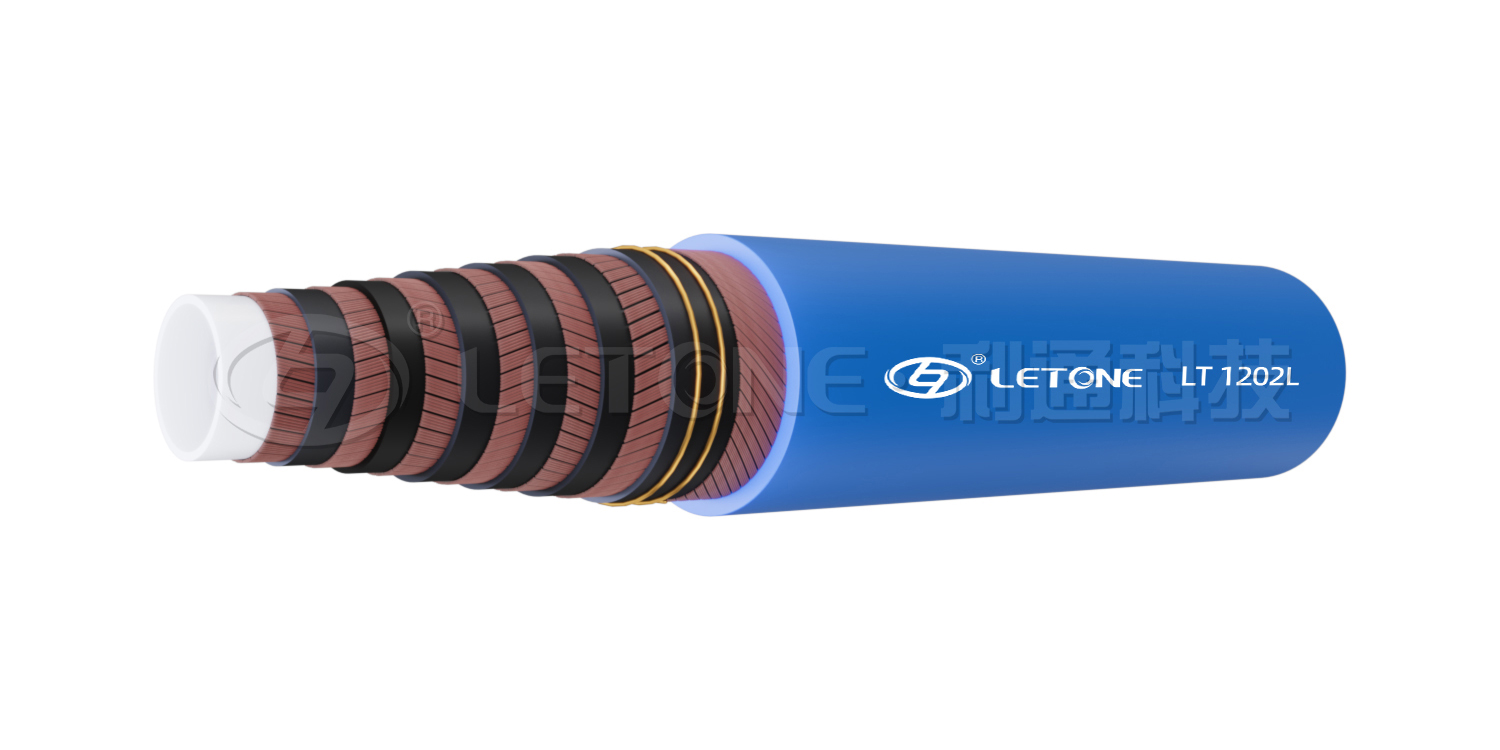
2. Precise Matching of Pressure and Temperature Boundary Parameters
Under high-pressure working conditions, it is necessary to clearly distinguish three core indicators: rated working pressure, design burst pressure, and pulse pressure. The general industry selection safety factor must reach 4:1, that is, the burst pressure is more than 4 times the actual working pressure, reserving sufficient safety margin for the system. In hydraulic and chemical pumping systems with frequent pressure fluctuations, it is necessary to focus on verifying the pulse pressure resistance times of the hose to avoid fatigue fracture of the reinforcement layer caused by repeated pressure cycles. The temperature parameters must cover both the medium temperature and the ambient temperature, and the more stringent condition of the two shall be used as the selection basis. The PTFE liner itself can maintain stable performance in the range of -60°C to +260°C, but the mechanical properties of the outer stainless steel wire reinforcement layer will change with temperature. In high-temperature scenarios, the rated working pressure needs to be appropriately reduced to prevent pressure failure caused by metal strength attenuation. The conventional two-layer stainless steel wire braided structure can withstand a pressure of 20MPa, and the four-layer cross braided structure can achieve a pressure resistance of more than 40MPa.
3. Compliance Verification of Composite Structure and Connection System
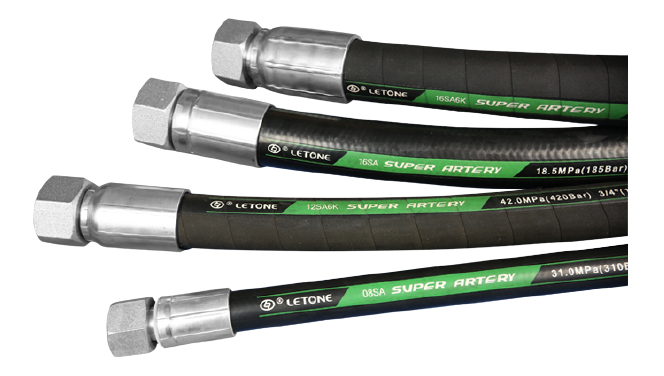
Qualified high-pressure PTFE acid and alkali resistant hoses for high-pressure working conditions must adopt a three-layer composite structure design: the inner layer is a PTFE liner with uniform thickness, the middle layer is a high-strength stainless steel wire reinforcement layer braided in multiple staggered layers, and the outer layer is a wear-resistant and aging-resistant polyamide or polyester protective layer. All mechanical loads are fully borne by the steel wire reinforcement layer, preventing the PTFE inner liner from directly bearing pressure and causing creep deformation. The selection of the connecting end also directly determines the reliability of the high-pressure system. The thread specification and sealing surface form of the joint must be completely matched with the system port. It is preferred to use stainless steel joints with the same material as the reinforcement layer to avoid electrochemical corrosion caused by contact of different metals. During installation, it is necessary to ensure that the hose is in a naturally relaxed state, the minimum bending radius is not less than 5 times the pipe diameter, and it is forbidden to forcibly twist or stretch the hose to prevent pre-set stress from greatly reducing the pressure resistance level.
4. Factory Inspection and Full Life Cycle Operation and Maintenance Standards
PTFE hoses used in high-pressure working conditions must pass two core factory tests: static pressure holding at 1.5 times the rated working pressure for 30 minutes without leakage, and 500 pulse fatigue tests at 0.5 times the working pressure without abnormality. At the same time, a complete material traceability report must be provided to clarify key parameters such as the PTFE resin batch and the mechanical properties of the steel wire. Daily operation and maintenance needs to establish a regular inspection mechanism, focusing on checking for abnormal signs such as bulges, rusted steel wires, and local wear on the outer protective layer. Systems with frequent pulse pressure are recommended to conduct a pressure resistance retest every 2 years. Hoses that reach the service life specified by the manufacturer must be forcibly replaced to eliminate safety accidents caused by high-pressure leakage due to extended service.
分享:
Relevant News
-
Letone Hydraulics sincerely invites you to participate in the "Germany Hannover Messe" and "Bauma
-
From April 8th to 14th, Letone Hydraulics invites you to participate in the Bauma Exhibition of Muni
-
The Bauma exhibition in Munich is waiting for you at booth C5.114 / D from April 8th to 14th!
-
The first announcement of the environmental impact assessment of the Luohe Letone Hydraulic Technolo
-
We sincerely invite you to participate in the "2019 Fifth China (Changsha) International Constructi
-
Letone Hydraulic "Public Hose Smart Factory Project with an Annual Output of 50 Million Meters" Pu
-
API 7K and API 16C series products successfully obtained ABS certification issued by American Burea
-
Price of EN856 4SH steel wire hose