Selection Scheme of Cold Plate Liquid Cooling Hose for High-Density Intelligent Computing Centers
2026-09-02
With the explosion of computing power demand for large model training and inference, the power consumption of a single AI server continues to rise. After the power density of a single cabinet exceeds 25kW, the traditional air cooling has reached the physical limit. Industry calculations show that the theoretical PUE value of the air cooling solution is difficult to be lower than 1.4, while the cold plate liquid cooling can stably control the refrigeration PUE below 1.1, and the full liquid cooling scenario can reach around 1.04, making it the mainstream technical route for new high-density intelligent computing centers. A newly built large intelligent computing center in East China plans to deploy 30-50kW high-density AI training cabinets, using 25% ethylene glycol aqueous solution as the coolant. The core requirement is to complete the flexible connection of thousands of cooling branches in the limited space inside the cabinet, achieve zero leakage and easy maintenance in the whole life cycle, and meet the flame-retardant and environmental protection requirements of the data center.
Five Core Pain Points in the Scenario of Intelligent Computing Liquid Cooling
In the project selection stage, the customer sorted out the key usage pain points of the liquid cooling pipeline system:
Leakage Risk Control: Industry data shows that the sealing failure of cold plate welds and quick connectors is the most common fault of liquid cooling systems. Coolant leakage will directly damage the live server motherboard, requiring the connection link to achieve "dry disconnection" without liquid spillage and support a redundant design with detectable and quick cut-off functions
Tight Cabinet Cabling Space: Power supply cables, network cables, optical fibers and liquid cooling pipelines are arranged simultaneously in the high-density cabinet, and the available channel width is only measured in centimeters. Traditional rigid metal pipes cannot complete compact U-shaped/return-shaped pipe routing
Strict Material Compatibility Requirements: Long-term circulation of ethylene glycol aqueous solution will erode the inner pipe wall and seals. Particles or ions precipitated from materials will contaminate the coolant and accelerate fouling in the micro-channels of the cold plate, and the pipeline materials must pass the long-term immersion compatibility verification
High Flame-Retardant Safety Requirements for Computer Rooms: Data centers have mandatory flame-retardant requirements for non-metallic pipelines. The outer cladding of the hoses must not become a flame propagation path, nor produce burning drips
Strictly Limited Operation and Maintenance Shutdown Window: The hardware of AI clusters is iterated frequently. The replacement of a single server involves the insertion and extraction of multiple cold plate cross-connect pipes. If each operation requires draining the pipeline and using special tools, the operation and maintenance cost and downtime will exceed the acceptable range.
Selection and Implementation of LT800 Series EPDM Liquid Cooling Hose
To solve the above pain points, the LT800 series EPDM liquid cooling hose system is selected, which is divided into two levels according to the deployment position: the LT800A cold plate-manifold cross-connect hose adapts to the capillary connection at the server end, and the LT800B/LT800C grid-connected hoses adapt to the large-flow connection between the CDU and the cabinet main pipe.
In the scheme comparison stage, the team compared three candidate materials: PTFE fluoroplastic hoses have good chemical inertness but high cost and large bending radius; stainless steel corrugated pipes have outstanding pressure resistance and service life but are prone to vibration conduction and heavy weight. Finally, the LT800 solution with peroxide-vulcanized high-purity EPDM inner tube and synthetic fiber braided reinforcement is selected. It has excellent chemical resistance and low precipitation characteristics in the water-ethylene glycol system, the minimum bending radius is as low as 2 times the pipe diameter, the cost is much lower than PTFE and metal pipes, and the weight is only 1/5 of the metal pipe of the same specification.
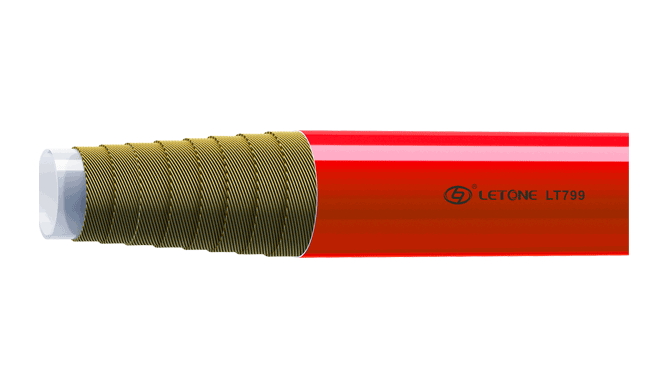
The core parameters of the product fully meet the project requirements: the inner tube is made of black high-purity EPDM synthetic rubber with smooth inner wall and low flow resistance; the reinforcement layer adopts 1-2 layers of synthetic fiber braided structure; the outer cover is made of weather-resistant and ozone-resistant special rubber, meeting the UL94 V0 flame-retardant grade; the working temperature covers -40°C~+120°C, the maximum working pressure is 1.0~1.38MPa, it is compatible with mainstream coolants such as deionized water and water-ethylene glycol, and the whole series has passed UL certification and helium leak detection.
Both ends of the hose are pre-installed with UQD dry quick connectors that meet the OCP open standard, with EPDM seals, red and blue colors marking the liquid supply/return directions. The sealing is maintained during the whole process of insertion and disconnection, realizing drip-free insertion and extraction and one-handed quick connection. The full series of specifications from -4 to -20 cover all scenario requirements from server cold plate cross-connection to CDU main pipeline.
Application Effect after Project Operation
The project is implemented in four stages: working condition verification, 3D pipe routing design, pre-installation deployment and system joint debugging. After operation, it has been running stably for more than half a year. Thousands of cooling branches have zero leakage under full load operation, low temperature environment and pump start-stop impact. The deployment time of liquid cooling pipelines in a single cabinet is reduced by two-thirds compared with the traditional rigid metal pipe solution. Together with the cold plate and CDU, the refrigeration PUE is stably below 1.1, fully meeting the design goal of green intelligent computing centers. The red and blue dual-color connectors greatly reduce the probability of wrong connection between liquid supply and return. No need to drain the whole cabinet loop during server hardware replacement. The UL94 V0 flame-retardant performance and UL certification qualification meet the fire protection requirements of computer rooms and the access requirements of overseas computing power nodes.
分享:
Relevant News
-
Letone Hydraulics sincerely invites you to participate in the "Germany Hannover Messe" and "Bauma
-
From April 8th to 14th, Letone Hydraulics invites you to participate in the Bauma Exhibition of Muni
-
The Bauma exhibition in Munich is waiting for you at booth C5.114 / D from April 8th to 14th!
-
The first announcement of the environmental impact assessment of the Luohe Letone Hydraulic Technolo
-
We sincerely invite you to participate in the "2019 Fifth China (Changsha) International Constructi
-
Letone Hydraulic "Public Hose Smart Factory Project with an Annual Output of 50 Million Meters" Pu
-
API 7K and API 16C series products successfully obtained ABS certification issued by American Burea
-
Price of EN856 4SH steel wire hose